


Across the United States, an estimated 88% of public school districts now employ some form of 1-to-1 computing, whereby every student is provided with a personal laptop or tablet for use at school (and oftentimes at home). Similar initiatives have spread to dozens of countries around the world, making 1:1 computing one of the defining educational reforms of the twenty-first century.
With such extraordinary global adoption, you’d assume these programs are supported by overwhelming evidence demonstrating substantial improvements in student learning.
Think again.
1-to-1 computer initiatives have one of the lowest effect sizes in the entire EdTech literature: approximately +0.12 (1, 2, 3). That’s less than one-third of the +0.42 benchmark commonly used to identify educational interventions with meaningful impact.
Put simply, one-to-one laptop programs consistently underperform many traditional, analog approaches to teaching and learning. Given the enormous financial investment and transformational claims made on their behalf, these modest results should give policymakers, educators, and parents pause.
So where did this whole movement begin?
Surprisingly, it began in one small U.S. state.
In 2002, Maine became the first jurisdiction in the U.S. - and one of the first in the world - to launch a statewide one-to-one laptop program. More than twenty years later, it remains the country's longest-running statewide 1:1 initiative.
If there is anywhere we should expect to observe the long-term benefits of one-to-one computing, it is here.
WELCOME TO MAINE
At a time when most schools still relied on shared desktop computer labs, Maine embraced a radically different vision: every student carrying a personal computer into every lesson, every day. The Maine Learning Technology Initiative (MLTI) sought to transform teaching and learning through digital technology - and more than two decades later, the program continues today.
Over the past quarter century, Maine has invested more than $450 million (adjusted for inflation) maintaining and expanding MLTI. What began in 2002 with seventh graders soon expanded to all public middle school students and participating high schools. Along the way, the procurement systems, infrastructure, and professional development established through the initiative helped accelerate the spread of digital technology throughout Maine’s public schools.
After more than twenty years, one question remains: did it work?
NAEP DATA
One way to address this question is to examine Maine’s relative performance on the National Assessment of Educational Progress (NAEP) – a set of exams often termed ‘the nation’s report card’.
Rather than looking at raw scores, I pooled each state’s reading and mathematics performance within each NAEP testing cycle and then rank-ordered all fifty states plus the District of Columbia.
Because Maine entered the 1:1 era as one of America’s highest-performing education systems, there wasn’t much room to climb higher. Accordingly, the question becomes whether it could maintain its educational advantage – because if the initiative delivered the transformational gains its advocates promised, we would expect Maine to remain among the nation’s leading education systems, not steadily lose ground relative to its peers.
After all, if you give the world’s strongest man steroids, you don’t expect him to shrink.
So, what do we see?
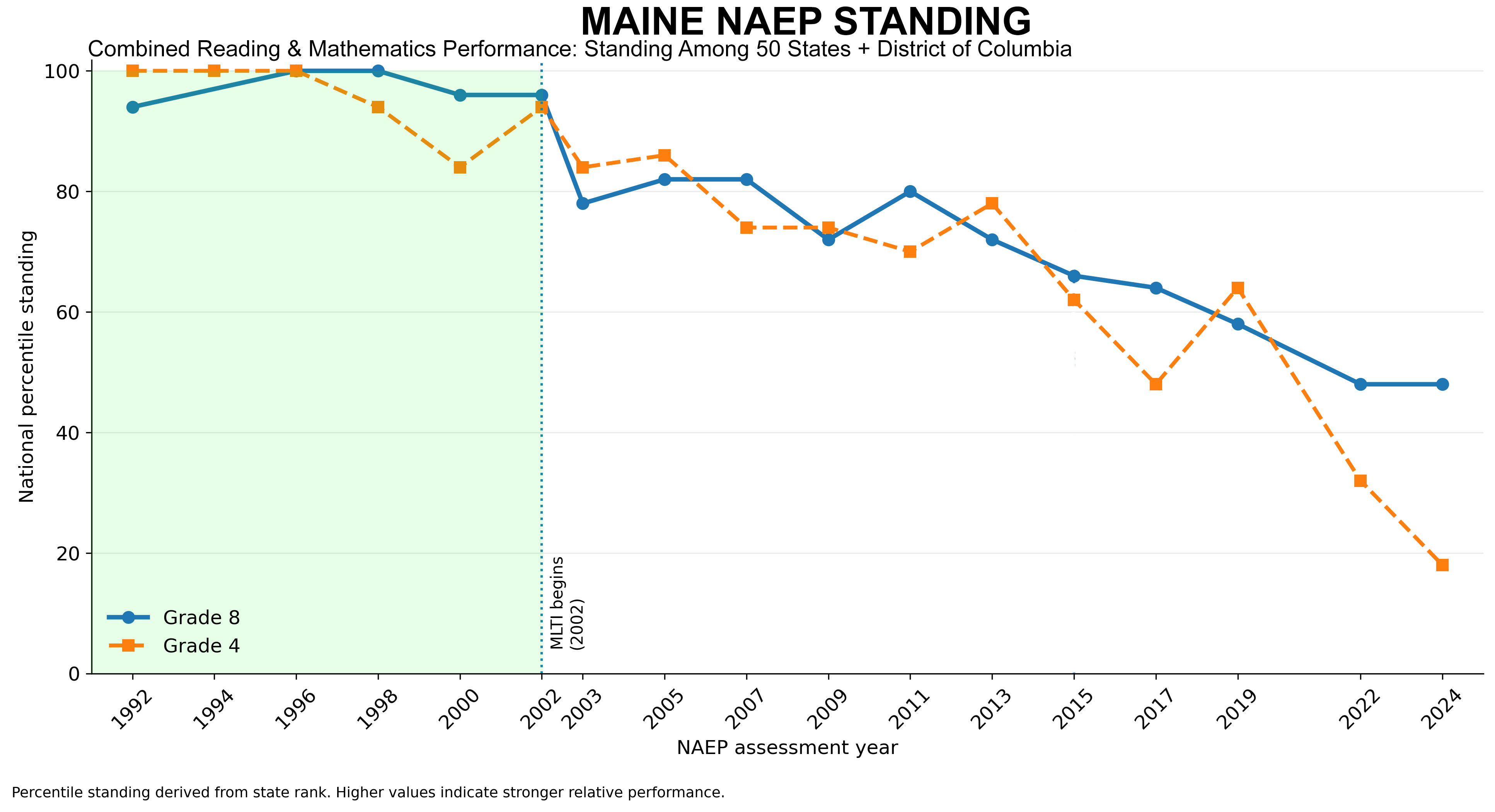
Between 1992 and 2002, Maine ranked among the nation’s highest-performing education systems, with both fourth- and eighth-grade students consistently placing near the top of the country. Following the launch of MLTI, however, Maine’s standing began a long-term decline. By 2024, Maine had fallen from one of America’s highest-performing education systems to roughly the middle of the pack in Grade 8, and the bottom quartile in Grade 4.
The COVID-19 pandemic makes the pattern even more intriguing.
If decades of investment in digital infrastructure and classroom technology genuinely conferred an educational advantage, Maine should have been among the states best positioned to withstand prolonged periods of remote and technology-mediated learning. Yet when the first post-pandemic NAEP results were released in 2022, Maine’s relative standing fell even further.
Is this proof that laptops harmed learning? Of course not - but it is certainly a curious pattern. A correlation is never the same thing as causation - but it is often exactly what we expect to observe if a causal relationship exists. This makes the data difficult to dismiss, particularly given the broader research literature on one-to-one computing.
It is important to note that educational outcomes fluctuate for many reasons: demographics change, policies evolve, teachers retire, funding shifts, and some cohorts simply perform differently than others. No single graph can disentangle those influences.
But Maine isn’t just another state adopting tech - it is the flagship of 1-to-1 computing. For more than two decades, Maine has pursued this initiative computing more consistently and comprehensively than any other American state. If ubiquitous student devices genuinely transformed learning, Maine should have had every opportunity to demonstrate it. Instead, while other states climbed past it in the rankings, Maine slowly surrendered one of the strongest educational positions in the country.
SIMILAR STATE - DIFFERENT OUTCOME
Any single state can follow an unusual NAEP trajectory. So, to place Maine’s experience in context, consider a neighboring state that began from a remarkably similar position.
Like Maine, Massachusetts entered the twenty-first century as one of America’s highest-performing education systems. These two New England states shared a long tradition of educational excellence, but they pursued markedly different approaches to classroom technology. While Maine became the first jurisdiction in the world to launch a statewide 1:1 laptop initiative, Massachusetts never implemented a comparable statewide program, leaving device adoption largely to individual districts.
Those policy differences translated into very different classroom experiences. In 2017, 55% of Maine eighth-graders reported having access to a laptop in all classes, compared with just 15% in Massachusetts. Two years later, 60% of Maine eighth-graders reported using a computer in all or most classes, compared with 34% in Massachusetts. It was only during and after the COVID-19 pandemic (when device access expanded rapidly across the country) that these gaps began to shrink.
So what happened in Massachusetts?
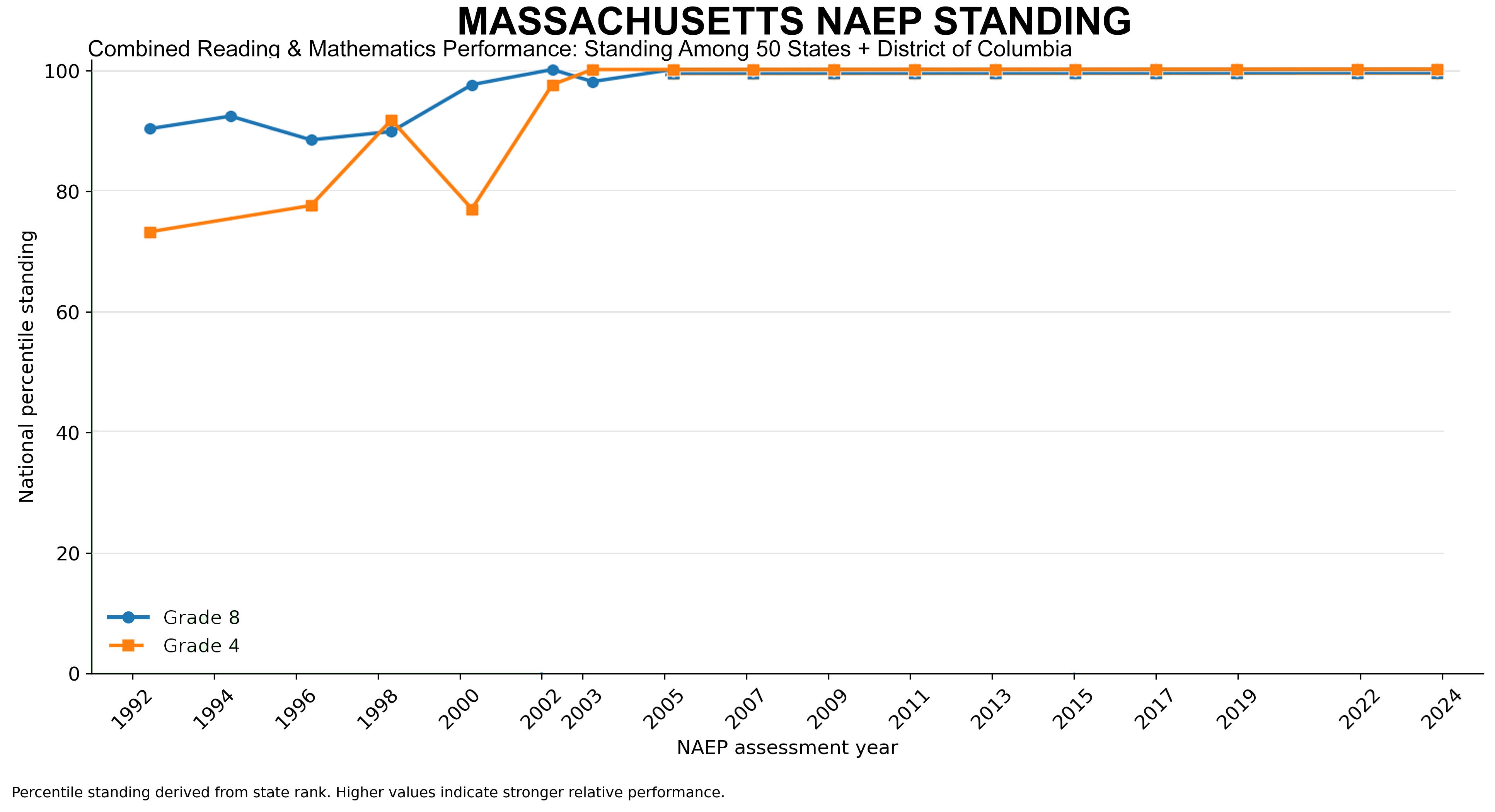
Unlike Maine, Massachusetts’ national standing did not gradually erode over the next two decades: it strengthened. By 2002, Massachusetts had risen to the top of the nation in fourth-grade achievement – and by 2003, it had done the same in eighth grade. Remarkably, it would remain at the top for more than twenty years.
Again, this comparison does not prove that lower levels of classroom technology caused Massachusetts’ success, nor that Maine’s digital initiatives caused its decline - many differences exist between the two states. But it does raise an obvious question: if aggressive statewide investment in classroom technology provides a substantial educational advantage, why did a neighboring state that pursued a far less aggressive technology strategy maintain its position at the very top while Maine steadily fell away?
SO NOW THEN…
The curious case of Maine doesn’t prove that 1-to-1 computing harms learning. But after more than 20 years and more than $450 million in public investment, the outcome is increasingly difficult to ignore.
Maine began this experiment as one of America’s highest-performing education systems – but today, its eighth-graders sit roughly in the middle of the national pack, while its fourth-graders have fallen to the bottom quartile.
So where is the evidence that the experiment succeeded? Where is the evidence that this is a model other states and countries should emulate? And where is the evidence that Maine itself should continue down this path?
After two decades, surely the burden of proof belongs with those still making the promises.
Loved The Digital Delusion! Your point that screens deliver information but not embodied understanding really stuck with us. We ended up writing a short research overview on exactly that tension in math learning, building on your ideas: [https://mathsuccess.dmtinstitute.com/p/from-screens-to-sense-making-what]. Thought you might enjoy seeing where it took us.
This is a great observation because it isolates the effect of 1:1 laptop programs in 2002 from the effect of personal smart phones in 2015.